








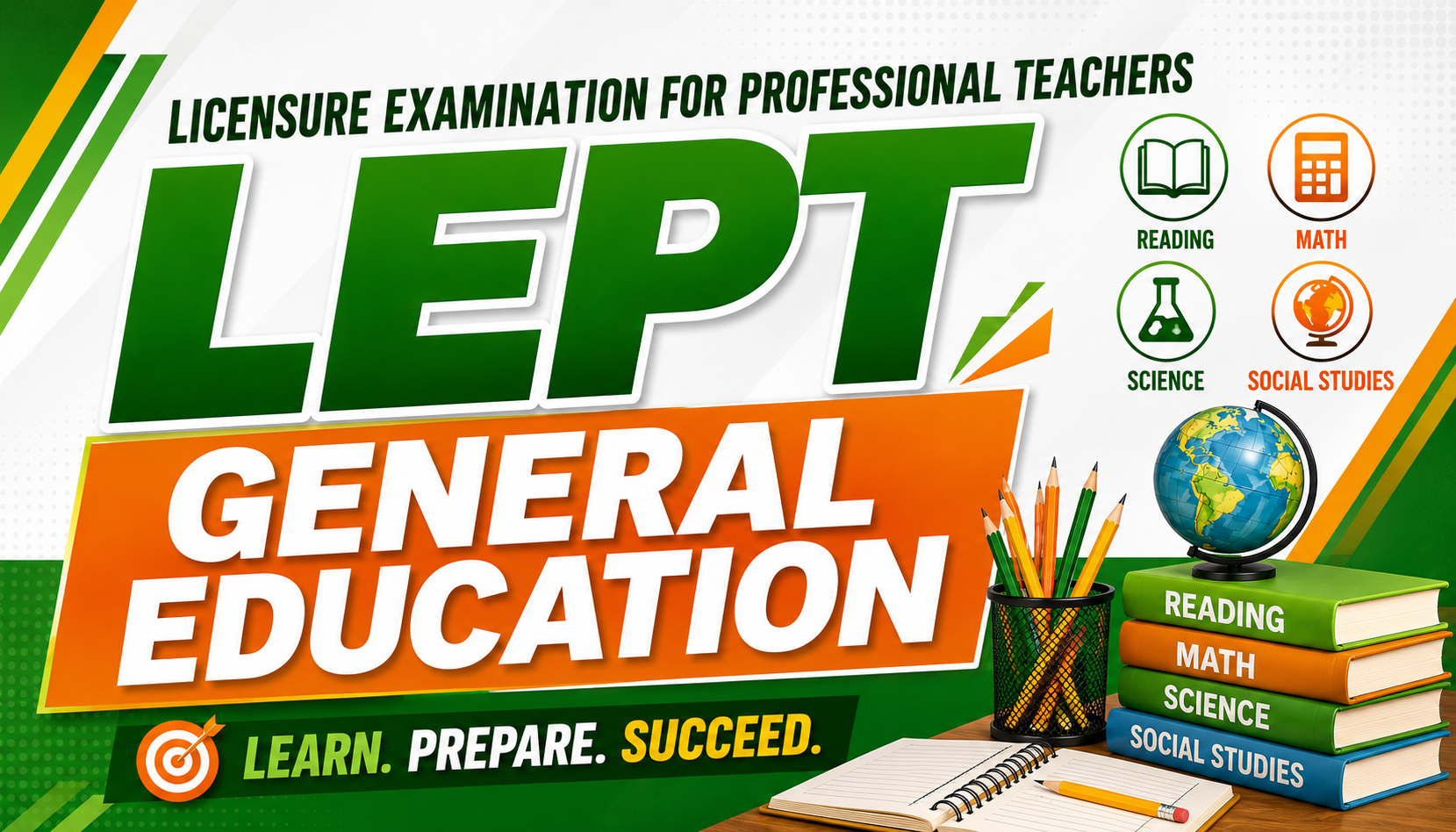
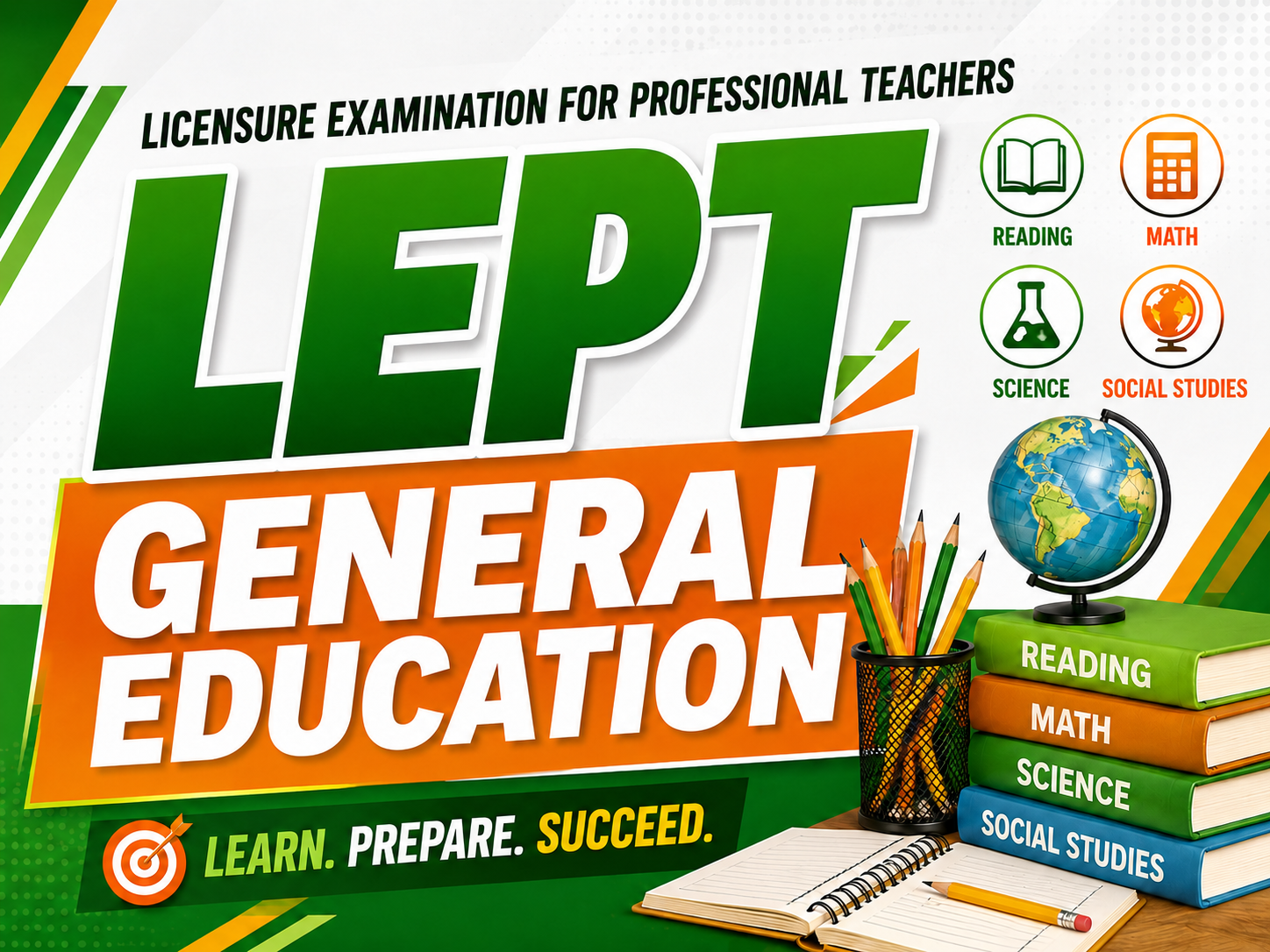
Licensure Examination for Professional Teachers (LEPT) - General Education
Organization
About This Course
The General Education Exam covers many different subjects, unlike specialization subjects that focus only on the teacher’s college major. This exam measures not only what the examinee remembers, but also their understanding, problem-solving ability, critical thinking, and application of knowledge. Many questions require careful reading, comprehension, and logical thinking to choose the correct answer.
General Education is important because future teachers should become well-rounded educators who can think critically, communicate effectively, and connect different subjects to real-life situations. No matter what specialization a teacher has, they are expected to have basic knowledge in subjects like English, Fiipino, Mathematics, Science, Social Studies, and Values Education (Ethics). The General Education component of the LEPT helps ensure that aspiring teachers have the knowledge and skills needed to become competent and effective professional educators.
The General Education Exam can be challenging for many LEPT examinees because it covers a wide range of subjects. It requires reviewing lessons learned from elementary, high school, and college. However, with proper preparation, regular practice, and continuous answering of review questions, examinees can improve their understanding, build confidence, and perform well in the examination.
Since the General Education Exam represents an important part of the whole LEPT score for both Elementary and Secondary Education courses, it is essential to do well in it. The examinee would greatly improve his or her overall average and pass the LEPT if he or she scores well in this subject area.
The General Education section has a 40% weight in the total LEPT score of BEEd graduates, thus playing a very important role in the overall evaluation. As teachers in the elementary level teach different subjects, it is essential that they have knowledge of all these different subject matters.
General Education constitutes around 20% of the entire score for those graduates who completed their Bachelor of Secondary Education (BSEd) degree. Teachers must become good educators overall, meaning that despite the fact that there are certain courses secondary teachers undergo, they are still expected to have basic skills in general subjects.
Low scores in other portions of the LEPT may be compensated by a high score in this part. Thus, for one to pass the board exam and get a teaching license, he needs to be well-versed in General Education subjects.
FAQ
Check the frequently asked questions about this course.
Soloo Academy
Related Courses
Explore newly published courses and stay updated.
Curriculum Overview
This course includes 2 modules, 7 lessons, and 0 hours of materials.
The General Education Examination of the LET Review Program covers essential knowledge and skills across various academic disciplines, including English, Filipino, Mathematics, Science, Social Sciences, Information and Communication Technology (ICT), and Current Issues. This subject area aims to strengthen foundational competencies, enhance critical thinking and problem-solving skills, and prepare examinees to answer a wide range of questions commonly encountered in the Licensure Examination for Teachers (LET).
The General Education Exam of the LET Review Program covers essential knowledge and skills across various academic disciplines, including English, Filipino, Mathematics, Science, Social Sciences, Information and Communication Technology (ICT), and Current Issues. This subject area aims to strengthen foundational competencies, enhance critical thinking and problem-solving skills, and prepare examinees to answer a wide range of questions commonly encountered in the Licensure Examination for Teachers (LET).
Answer all questions independently. Do not proceed to the next question until you have selected your answer for the current item. Time yourself for 2 hours, the same time allotment given for the General Education component of the actual LET. Work carefully, manage your time wisely, and avoid using notes, references, or outside assistance while taking the examination. Remember, this mock exam is designed to measure your current level of preparedness and identify areas where further improvement is needed. Be honest with your answers. Cheating only defeats the purpose of the exercise—you are not cheating the examiner but yourself, and you risk wasting the time and effort you have invested in your review.
Course Specifications
Send Course as Gift
Soloo Academy
Soloo Academy connects learners, professionals, and organizers through engaging online and in-person events, offering expert-led workshops, networking opportunities, skill-building sessions, and learning experiences for everyone.


Reply to Comment